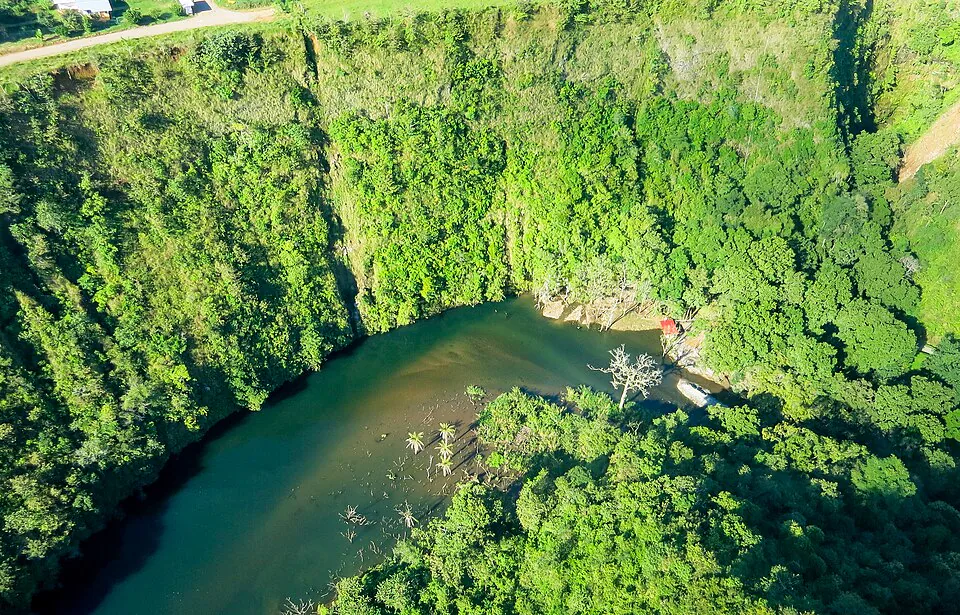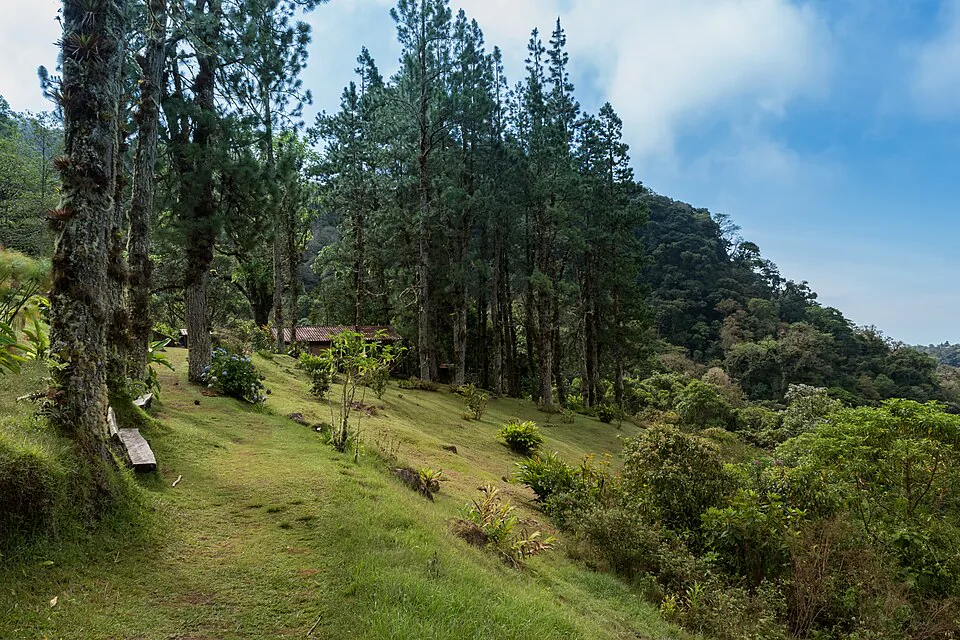
The Caldera Hot Springs sit on a private farm in the Caldera Valley, roughly 25 minutes south of Boquete town. Three geothermally heated pools range from 38°C to 45°C (100°F–113°F), the Río Caldera runs cold a few steps away, and the entrance costs $7 per person in cash. That is the short version. What no other guide tells you is exactly how to get there without getting lost, which pool is actually worth soaking in, whether the road will eat your rental car, and why the month you visit matters more than you think.
The springs sit on land that belongs to a local farming family who have been welcoming visitors for decades. Nothing has been engineered or manicured. The pools are rock-lined depressions fed by geothermal seepage from the volcanic system anchored by Volcán Barú, Panama's highest peak. That rawness is the whole point. Come expecting a spa and you will be disappointed. Come expecting a quiet afternoon in a jungle river valley with genuinely hot mineral water and you will leave planning a return trip.
Section 01Why go to the Caldera Hot Springs
The honest answer: because they are one of the cheapest and most atmospheric natural experiences in western Panama, and because almost every other activity in Boquete involves significant physical effort. After hiking the Lost Waterfalls trail, summiting Volcán Barú, or white-water rafting the Chiriquí Viejo, your legs will thank you for an afternoon of doing nothing but floating in 40°C mineral water.
The springs are also genuinely uncrowded by regional standards. On a weekday morning you may have all three pools to yourself or share them with a handful of Panamanian families. Weekends bring more visitors, but the site never reaches the shoulder-to-shoulder density of better-known thermal destinations in Costa Rica or Colombia. The setting — open valley, cattle pastures, a cold river, birds overhead — is the kind of place that feels accidental and therefore more valuable.
The water itself is sulphurous and mineral-rich, heated by the same volcanic system that created the Barú caldera. Regular visitors report relief from muscle soreness and joint stiffness, which is consistent with the documented properties of sulphate-bicarbonate thermal waters. There is no peer-reviewed study on this specific site, but the anecdotal evidence from the Boquete expat and visitor community is consistent enough to take seriously.
Section 02Location and exact directions
The springs are located in the village of Caldera, Chiriquí Province, on a private farm near the Río Caldera. The village sits roughly 15–20 km south of Boquete town along Highway 10 (the Carretera Nacional). In good conditions the drive takes 20–25 minutes from Boquete's central plaza. From David it is approximately 30–35 minutes heading northeast through Dolega.
Do not follow Google Maps all the way to the springs. Multiple visitors have reported being directed through locked private gates or onto tracks that dead-end. Use Google Maps to navigate to the town of Caldera, then follow the directions below on the ground.
Coming from Boquete on Highway 10, drive south approximately 11 km. Watch for the overhead pedestrian walkway (pasarela) that crosses the highway — it is the most visible landmark in the village. Turn left just before the walkway. If you cross the walkway, you have gone too far. Stay left at the first fork after the turn. The road becomes unpaved after a few hundred metres. Continue toward the Río Caldera; the farm entrance and a small parking area are on the right side, just before the river bridge. A handwritten sign usually marks the entrance, though it has been known to disappear after heavy rains.
The final 800 metres of road before the farm entrance is unpaved gravel and dirt with potholes that deepen significantly during and after the rainy season (May–November). A standard sedan can manage it in dry conditions if driven carefully, but any car with low ground clearance will scrape. A 4x4 or high-clearance SUV removes the stress entirely and is strongly recommended from May through November. Rental cars from David typically include basic insurance that does not cover tyre or undercarriage damage on unpaved roads — factor that in.
Section 03Getting there from Boquete
You have four realistic options: rental car, taxi, collectivo bus, or organised tour. Each involves different trade-offs on cost, convenience, and flexibility.
| Option | Cost (per person) | Time | Verdict |
|---|---|---|---|
| Rental car (self-drive) | $0 marginal once rented | 25 min each way | Most flexible |
| Taxi from Boquete | $20–25 one way; $40–50 return with wait | 25 min each way | Best for small groups |
| Collectivo bus | $1–2 one way + 3 km walk | 45–60 min each way | Budget option |
| Organised tour | $35–55 per person | 4 hrs total | Easiest logistics |
Rental car: The most practical option if you are already renting in Boquete or David. You control your arrival time, can stay as long as you like, and can combine the springs with other stops (the Caldera petroglyphs are a 10-minute detour on the same road). Rent from David's city centre or David Tocumen airport — agencies include Hertz, Budget, and several local operators. Expect to pay $40–70/day for a basic 4x4.
Taxi: Taxis from Boquete's central plaza to the springs cost approximately $20–25 one way as of 2025. Negotiate a return fare with waiting time before you leave — most drivers will agree to $40–50 for the round trip including two to three hours at the site. This is genuinely good value split between two or three people. Ask your hotel or hostel to call a trusted driver; random street taxis occasionally quote inflated rates to tourists.
Collectivo bus: The cheapest option but requires planning. Collectivos to Caldera depart from Boquete's small bus terminal (Parada de buses pequeños) roughly every 30 minutes. Tell the driver "pozos termales" and they will drop you at the junction on Highway 10. From there it is approximately 3 km (1.9 miles) on foot to the farm entrance — a flat, easy walk along the unpaved road that takes 35–45 minutes each way. The last collectivo back to Boquete typically departs the junction around 3:00–3:30 pm; do not miss it or you will be negotiating a taxi from the roadside. The one-way fare is $1–2 depending on the driver.
Organised tour: Several Boquete operators run half-day hot springs tours departing at 8:30 am and 1:30 pm. Prices range from $35 to $55 per person and typically include round-trip transport from your hotel, a bilingual guide, and the entrance fee. The guide adds genuine value — they know the road, can explain the geology, and often include a stop at the nearby pre-Columbian petroglyphs. Tours last approximately four hours. Book directly with operators in Boquete town or through your accommodation.
Three rides. One unforgettable Boquete.
Premium Orbea e-bikes that do the climbing for you. Helmet, gloves, water and route support included — and you pay when you arrive.
Coffee Farm E-Bike Tour
Ride to a working farm and see how Geisha — the world's most expensive coffee — is made. Tasting at Altieri Specialty Coffee, geisha ice cream included.
Guided Highlights Ride
Lost Waterfalls, Library Park and the highland viewpoints locals love — the spots most visitors never find.
Self-Paced Rental
Hourly or full-day. Take a recommended route or just wander. The e-bike means hills don't decide your day.
Section 04The pools explained, one by one
There are three main thermal pools at the site, each at a different temperature. A fourth smaller pool exists but is often out of service or too shallow to use comfortably. The pools are natural rock formations reinforced with placed stones; none have tiled edges or chemical treatment.
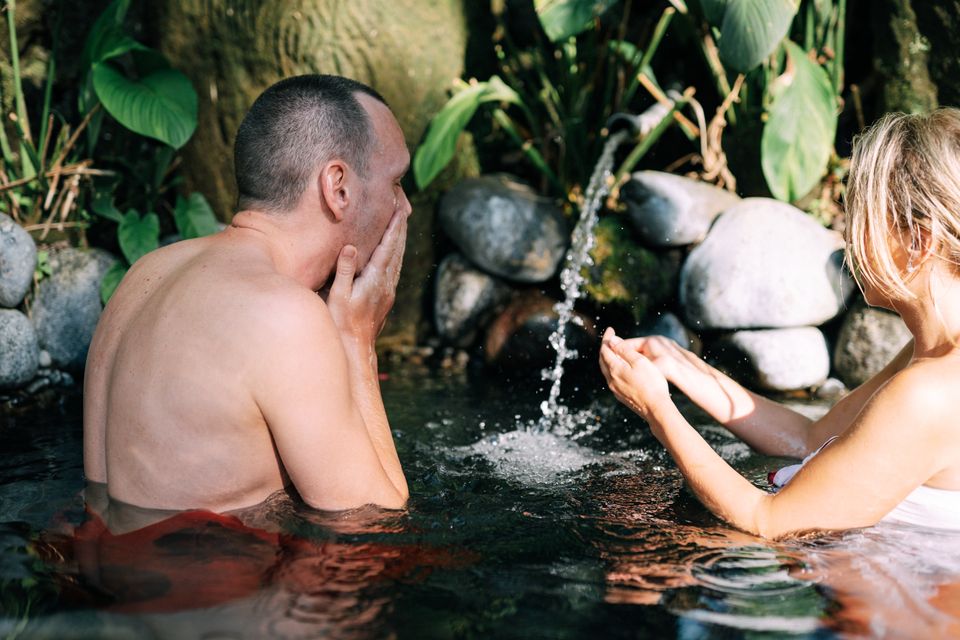
Pool 1 — The entry pool (approx. 38°C / 100°F): The coolest of the three and the largest in surface area. This is the one most visitors spend the majority of their time in. The temperature is hot enough to feel genuinely therapeutic but manageable for extended soaking — 20 to 30 minutes is comfortable for most adults. Depth ranges from knee-height at the edges to chest-height in the centre. This pool is the most accessible for people with limited mobility; the approach is relatively flat and the entry point has natural rock steps. Families with children tend to congregate here.
Pool 2 — The middle pool (approx. 40°C / 104°F): Slightly smaller and noticeably hotter. The sulphur smell is stronger here, which is a sign of more active geothermal input. Most visitors find 10–15 minutes the comfortable limit before needing to cool off. This is the pool that most reliably produces the post-soak muscle-relaxation effect. The entry is a little steeper than Pool 1.
Pool 3 — The hottest pool (approx. 45°C / 113°F): Not everyone makes it into this one. At 45°C the water is genuinely scalding to unacclimatised skin and most people manage only a few minutes. The pool is small — room for three or four people — and sits furthest from the river. The recommended strategy is to alternate: two minutes in Pool 3, then wade into the Río Caldera (which runs cold year-round) to reset your skin temperature, then repeat.
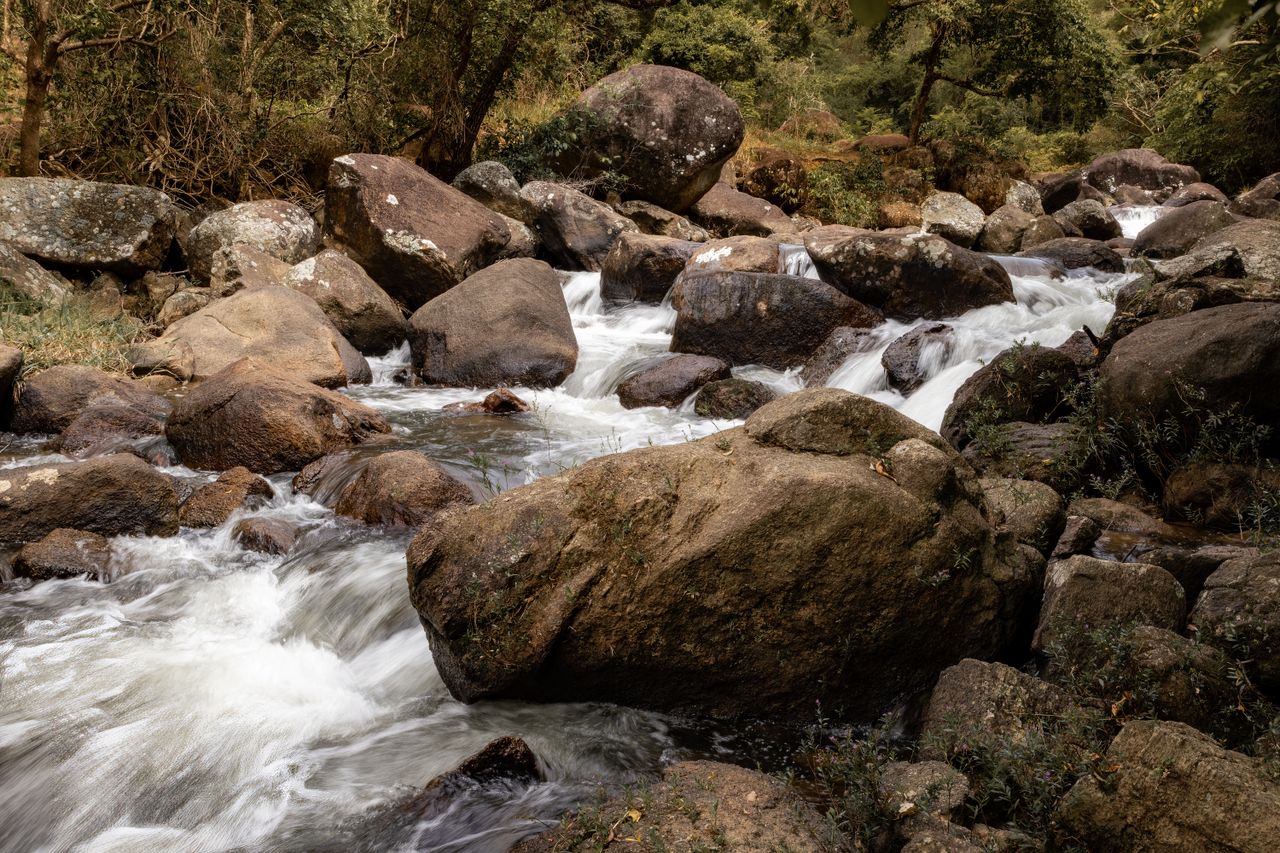
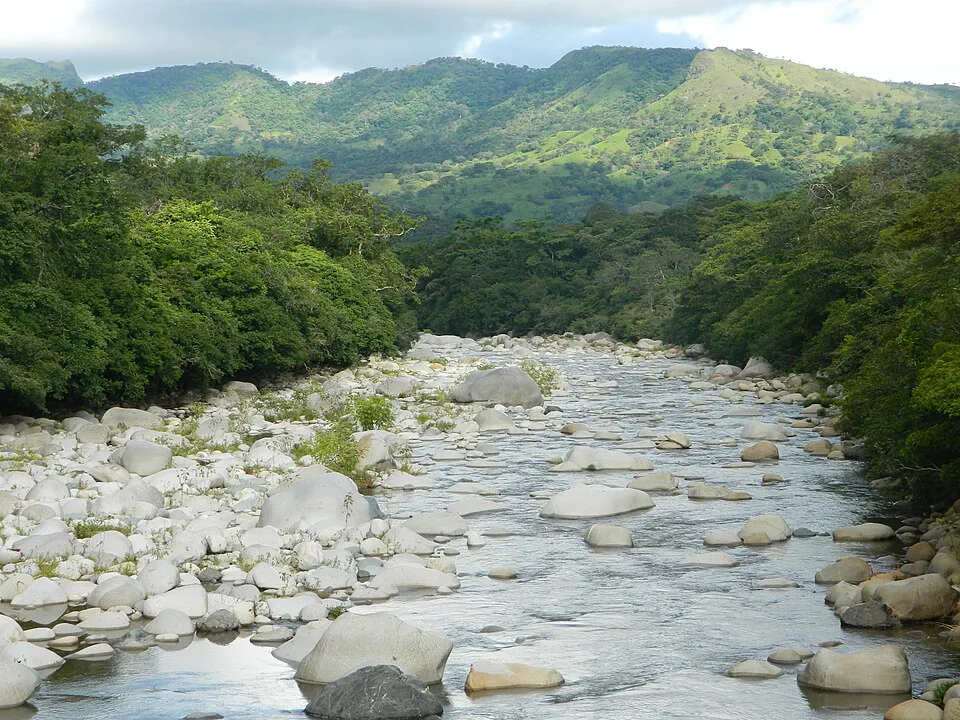
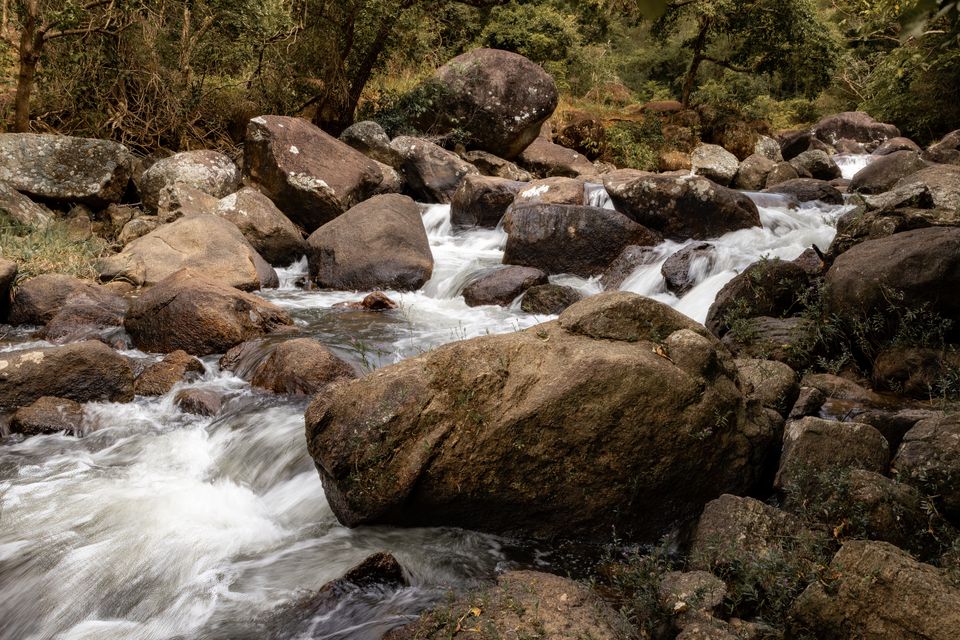
The Río Caldera: The river is not a pool but it is arguably the best feature of the site. Cold, clear, and fast-moving over smooth boulders, it runs within 20 metres of the pools. Alternating between the hottest pool and the cold river is the classic local experience — a natural version of the contrast therapy used in Nordic spas. The river also has isolated warm pockets where geothermal water seeps through the riverbed; a guide can point these out.
Section 05Entry fees and what is actually included
The current entrance fee is $7 USD per person, cash only, as of mid-2025. This is a private farm and the fee goes directly to the family that owns and maintains the site. There is no card reader, no receipt machine, and no ATM within 20 minutes — bring exact change or small bills.
You will notice a discrepancy if you read older guides: the fee was $3 for many years, then rose to $5, and reached $7 around 2022–2023. It has held at $7 since. Some tour operators include the entrance fee in their package price; confirm this when booking.
What the $7 covers: access to all three pools, access to the river, and use of a basic changing area (a simple structure with no running water). What it does not cover: parking (free, informal), a guide, food, drinks, or any equipment. There are no lockers. There is no food or drink for sale on site. There are no formal toilet facilities — a basic latrine exists but its condition varies. Plan accordingly.
Section 06Best time to visit — month by month
The dry season (December through April) is the unambiguous best time to visit. The road is passable in any vehicle, the river runs clear, and afternoon rain is rare. January through March are the peak months for Boquete tourism generally, which means more visitors at the springs on weekends — but even at peak season the site rarely feels overcrowded.
The rainy season (May through November) is more complicated. The springs themselves remain open and the water temperature does not change — geothermal heat is unaffected by surface weather. What changes is the road. The final unpaved section to the farm becomes progressively worse through the rainy season, with deep ruts and standing water by September and October. A 4x4 is not optional in those months; it is mandatory. The river also runs higher and faster after heavy rain, making the cold-plunge experience less pleasant and occasionally unsafe if there has been significant upstream rainfall.
If you are visiting Boquete during the rainy season and want to do the springs, go in the morning before the daily rains begin (typically 1–3 pm in the valley). Allow extra time on the road in both directions. Check with your hotel or hostel the morning of your visit — locals will know if there has been overnight rain severe enough to make the road genuinely impassable.
| Month | Road condition | Crowds | Verdict |
|---|---|---|---|
| Dec – Apr | Good; sedan passable | Moderate (peak season) | Best window |
| May – Jun | Deteriorating; 4x4 advised | Low | Manageable |
| Jul – Aug | Rough; 4x4 required | Moderate (school holidays) | Go early |
| Sep – Oct | Poor; deep ruts possible | Very low | 4x4 only |
| Nov | Improving; 4x4 still advised | Low | Check conditions |
Section 07What to bring
The site has no services. Everything you need for a comfortable visit must come with you from Boquete. This is not a hardship — it is a 25-minute drive — but visitors who arrive unprepared consistently rate the experience lower than those who come equipped.
- Swimwear: Nudity is not permitted. A swimsuit or board shorts are required.
- Water: At least 1.5 litres per person. Soaking in hot water is dehydrating. The site has no drinking water.
- Snacks or a packed lunch: There is nothing for sale. If you are spending two to three hours, bring food.
- Towel: A quick-dry travel towel takes up minimal space and dries fast in the valley heat.
- Water shoes or sandals: The pool floors and river rocks are uneven. Flip-flops work but water shoes with grip are better.
- Cash ($7 per person, plus extra for taxi tips): See above.
- Sunscreen: The valley is open and sunny. Apply before you arrive — the family asks that you do not apply sunscreen in the pools, as it affects water quality.
- Insect repellent: Less critical than in the cloud forest, but useful for the walk and the river area.
- Dry bag or ziplock bags: For phones and valuables. There are no lockers.
- Change of clothes: The changing area is basic. Having dry clothes in a bag in the car is simple and appreciated after a long soak.
Section 08Self-guided vs. organised tour
You can absolutely visit the Caldera Hot Springs independently. The site is on private property but is open to the public; you pay at the gate and do not need a guide to access the pools. The main arguments for going self-guided are cost and flexibility — you leave when you want, combine stops as you see fit, and pay $7 instead of $35–55.
The main arguments for a tour are navigation (the road genuinely confuses first-time visitors), the petroglyphs stop (a guide makes these meaningful; without context they are just carved rocks), and transport if you do not have a rental car. A good guide also knows the river's warm pockets, can explain the geology, and will have a vehicle capable of the road in any season.
Our recommendation: if you have a rental car and are comfortable navigating with offline maps, go self-guided. If you are relying on taxis or public transport, an organised tour is worth the premium for the hassle it eliminates. Solo travellers in particular benefit from the social aspect of a small-group tour — the springs are more enjoyable with company.
One note on safety for solo visitors: tell someone at your accommodation where you are going and when you expect to return. Cell service is unreliable in the valley. This is not a dangerous destination, but basic communication protocol is sensible anywhere in rural Panama.
Section 09Safety and practical health considerations
The Caldera Hot Springs are not a medically supervised facility. The following applies to any natural thermal site and is worth stating clearly because almost no guide addresses it.
Cardiovascular conditions: Prolonged immersion in water above 40°C raises core body temperature and increases heart rate. People with heart conditions, high blood pressure, or circulatory disorders should consult a doctor before visiting and should limit time in the hotter pools. The cooler 38°C pool is generally considered safe for most adults.
Pregnancy: Sustained immersion in water above 38°C is not recommended during pregnancy, particularly in the first trimester. The 38°C pool may be tolerable for brief periods, but medical advice before visiting is strongly recommended.
Children: Children can use the cooler pool comfortably. Keep them out of the 45°C pool — the temperature is genuinely dangerous for small bodies. Supervise children near the river at all times; the current is stronger than it looks.
Dehydration: Hot springs accelerate fluid loss. Drink water before, during, and after soaking. Alcohol before or during soaking is a bad idea and increases dehydration risk significantly.
Nearest medical facility: The Hospital Regional de David is the nearest significant medical facility, approximately 35–40 minutes south of the springs. Boquete has a small health centre (MINSA) but limited emergency capacity. For anything serious, David is your destination.
Water quality: The pools are natural and untreated. They are not chlorinated. The high temperature of the water (particularly Pools 2 and 3) inhibits most bacterial growth, but the cooler Pool 1 is more susceptible to contamination, especially after heavy visitor days. Avoid submerging your head and keep the water away from open cuts or wounds.
Section 10Caldera Hot Springs vs. Ojo de Agua in El Valle de Antón
This comparison comes up constantly in Panama travel forums and no guide has addressed it directly. The two sites are genuinely different experiences and the right choice depends on what you are after.
| Feature | Caldera (Boquete) | Ojo de Agua (El Valle) |
|---|---|---|
| Water source | Geothermal / volcanic | Cool freshwater spring (not thermal) |
| Temperature | 38–45°C (genuinely hot) | Ambient / cool (not a hot spring) |
| Entry fee | $7 USD | $2–3 USD |
| Facilities | Minimal — basic changing area only | Pools, changing rooms, food vendors |
| Setting | Raw, rural farm; river access | Developed park; more manicured |
| Crowds | Low to moderate | Moderate to high on weekends |
| Best for | Therapeutic soaking, raw nature | Swimming, families, convenience |
The critical point: Ojo de Agua in El Valle is not a hot spring. It is a cold freshwater spring fed pool — pleasant for swimming but not geothermally heated. If you want actual hot mineral water, Caldera is the destination. If you want a developed swimming facility with food nearby, El Valle is more convenient. They are not substitutes for each other.
Section 11Building a full day around the hot springs
The springs work best as the centrepiece of a half-day or as the afternoon component of a full Boquete day. Two to three hours at the site is the sweet spot — long enough to cycle through all three pools and the river, short enough that you are not sitting in hot water until you prune. Here is a practical full-day itinerary that works in either direction.
Morning-first version (recommended in dry season): Leave Boquete by 8:00 am to beat the heat and any weekend crowds. Arrive at the springs by 8:30 am, soak until 11:00–11:30 am, drive back via the Caldera petroglyphs (10-minute stop, signposted on the same road). Return to Boquete for lunch at one of the cafés on Avenida Central, then spend the afternoon at a coffee farm — there are several within 15 minutes of town that offer 90-minute tours for $15–20 per person.
Afternoon version (works year-round, especially in rainy season): Spend the morning at a coffee farm or on the Lost Waterfalls trail, then drive to the springs for a 1:00–1:30 pm arrival. The afternoon rains in the valley typically arrive later than in the cloud forest, giving you a window until 3:00–4:00 pm. Leave by 3:30 pm at the latest to ensure you are off the unpaved road before any afternoon downpour softens it.
If you want to combine the highland scenery of Boquete with the springs in a single loop without the logistics headache, E-Valley Bikes offers guided e-bike tours around Boquete that can be paired with a taxi run to Caldera — the e-bike portion covers the coffee farms and highland viewpoints in the morning, and the springs make a natural afternoon finale. It is a genuinely good way to cover a lot of ground without a rental car.
One underrated addition to the itinerary: the Caldera petroglyphs. These pre-Columbian rock carvings are located on a boulder near the river, a short detour off the main road to the springs. They are easy to miss without a guide but take only 10–15 minutes to visit. Most tour operators include them automatically; self-drivers should ask locals to point them out.