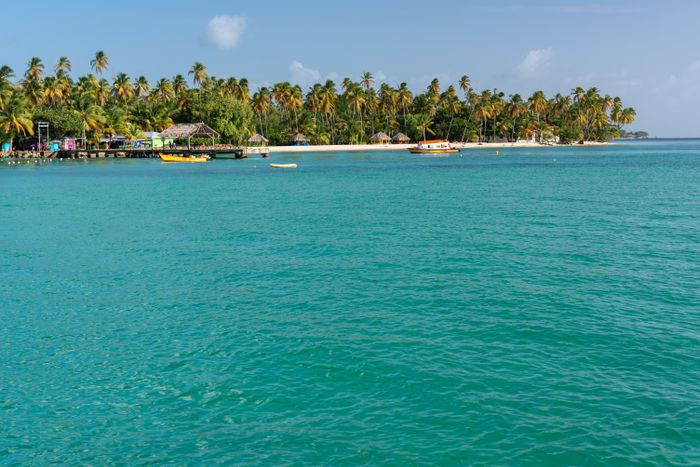
Red Frog Beach is the most photographed stretch of sand in the Bocas del Toro archipelago — a crescent of white sand backed by dense Caribbean rainforest on Isla Bastimentos, named for the strawberry poison-dart frogs that live in the leaf litter just inland. Getting here takes a little effort, and knowing what to expect before you go makes the difference between a frustrating half-day and one of the best beach experiences in Panama.
This guide covers everything the resort websites and TripAdvisor snippets leave out: the exact logistics of getting from Bocas Town to the beach, the current day-pass fee and what it actually covers, honest swimming and surf conditions, how to actually find a red frog (most visitors miss them entirely), what to do in Old Bank village, and how Red Frog stacks up against the other beaches on Bastimentos.
Section 01Why Red Frog Beach is worth the trip
Red Frog Beach earns its reputation not from any single feature but from the combination: the sand is genuinely white and fine, the rainforest presses right to the waterline in places, and the relative effort required to reach it keeps the crowds manageable compared to Starfish Beach on Isla Colón. On a weekday in the shoulder season you can find yourself sharing the beach with a dozen people at most.

The beach runs roughly 800 metres end to end. The eastern section near the main access point is where most day-trippers congregate around the bar and picnic tables. Walk ten minutes west and the crowd thins to almost nothing. At high tide the sea swallows the narrower sections and the rainforest canopy hangs directly over the water — genuinely beautiful, and the light in the late afternoon turns the whole scene amber.
The waves are consistent and powerful enough to attract serious surfers, particularly at the western end. This is not, however, a calm swimming beach — more on that below. Come for the scenery, the wildlife, the surf, and the sense of being somewhere genuinely remote despite being only 15 minutes by boat from Bocas Town.
Section 02Getting to Red Frog Beach step by step
The only practical way to reach Red Frog Beach is by water taxi. There is no road connection and the hiking trail from Old Bank, while doable, is not the standard route for day visitors. Here is the full logistics breakdown.

From Bocas Town (Isla Colón): Walk to the main water taxi dock on Calle 3, next to Hotel Bocas del Toro. Tell any of the boat operators you want Red Frog Beach on Bastimentos. The ride takes 10–15 minutes depending on sea conditions and the route the driver takes through the mangrove channels. Expect to pay $5–8 per person each way. Prices are not fixed and operators will quote the higher end to tourists — $5 is a fair price, $8 is what you'll pay if you don't ask around. Boats run from roughly 7 am to 5 pm. There is no formal schedule; boats leave when they have enough passengers or when you negotiate a private charter (around $20–25 for the whole boat).
From Old Bank village (Bastimentos Town): If you are already staying on Bastimentos, a local water taxi from Old Bank to Red Frog Beach costs $5 per person each way. The ride is shorter — about 5 minutes around the eastern tip of the island.
The boardwalk crossing: Some operators drop passengers at a dock on the northern (Caribbean) side of the island, from which a well-maintained elevated boardwalk leads to the beach in about 5–8 minutes. This is the "shortcut" route used by the resort. Other operators go directly around the island to the beach-side dock. Ask your driver which route they use — the direct route is faster and avoids the $5 beach access fee being bundled into a higher boat price.
| Route | Cost (one way) | Time | Verdict |
|---|---|---|---|
| Bocas Town → Red Frog (direct) | $5–8/pp | 15 min | Easiest |
| Old Bank → Red Frog (water taxi) | $5/pp | 5 min | Best if staying on Bastimentos |
| Old Bank → Red Frog (boardwalk hike) | $0 boat cost | 25–35 min walk | Scenic but sweaty |
| Private charter from Bocas Town | $20–25/boat | 15 min | Worth it for groups of 4+ |
Section 03Day pass, access fees, and what's included
Non-resort guests pay a beach access fee of $5 per person, collected at the entrance point near the main dock. This is a private fee charged by the Red Frog Beach Island Resort, which controls access to the main beach area — not a government or national park fee. The fee covers use of the beach, the picnic tables, and the public bathrooms. It does not include use of the resort pool, sun loungers, or any food and drink.
If you arrive via the boardwalk route from the northern dock, the fee is collected at the boardwalk entrance. If your water taxi drops you directly at the beach-side dock, it is collected there. Either way, you will pay it — there is no way around it for day visitors and it is not worth trying to avoid, as the resort staff are present and the beach access points are controlled.
Resort guests and people staying at properties within the Red Frog Beach development (including Red Frog Bungalows Resort) do not pay the day-pass fee. If you are staying at Palmar Beach Lodge, which is on the same beach but independently operated, confirm with them whether the fee applies to their guests — policies have varied.
Children under a certain age are sometimes waved through for free; this is at the discretion of whoever is collecting fees on the day. There is no printed price list posted at the entrance, so the $5 figure is the standard rate reported consistently by visitors as of 2025–2026.
Section 04Swimming and surf conditions — the honest version
Red Frog Beach has a reputation as a "rough" beach and that reputation is accurate. The Caribbean swell hits the northern shore of Bastimentos with consistent force, and the waves at Red Frog are generally 1–2 metres, sometimes larger during the September–November swell season. The beach break is powerful and the shore dump can knock you off your feet.

Can you swim at Red Frog Beach? Yes, but with caveats. A sandbar roughly 10–15 metres offshore creates a slightly calmer zone where the wave energy dissipates. This is where most non-surfers get in the water. It is not a calm lagoon — expect to be knocked around — but it is swimmable for confident adults. Children and weak swimmers should be supervised closely and should not go beyond waist depth near the shore break.
Is it safe? The main hazards are the waves themselves and rip currents, which can form along the beach particularly at the western end. There are no lifeguards. Sea urchins are present on the rocky sections at each end of the beach — wear reef shoes if you plan to walk on the rocks. Stingrays occasionally rest in the sandy shallows; shuffle your feet rather than stepping down firmly when wading in. There is no documented history of shark incidents at this beach.
Water temperature runs 27–29°C year-round — no wetsuit needed. Visibility in the water near the beach is generally poor due to wave action and suspended sand. Do not come to Red Frog expecting to snorkel; the surf makes it impractical and the reef here is not the draw.
For surfers: The western end of Red Frog Beach has a consistent beach break that works best on a medium swell with offshore winds (typically morning). It is not the most technical wave in Bocas — that title goes to Silverbacks on the outer reef — but it is accessible and fun for intermediate surfers. Red Frog Bungalows Resort caters specifically to surfers and can arrange board rentals and local knowledge on conditions.
Section 05How to actually spot the red frogs
The strawberry poison-dart frog (Oophaga pumilio) is the animal for which this beach is named, and yet the majority of visitors leave without seeing one. This is almost entirely a matter of knowing where and how to look.
Where: The frogs live in the leaf litter and low vegetation of the rainforest that borders the beach — not on the beach itself. The boardwalk trail between the northern dock and the beach is the single best place to look. Slow down, crouch, and scan the forest floor on either side of the boardwalk. The frogs are also found in the vegetation immediately behind the beach, particularly near the base of heliconia plants and bromeliads where they breed in the water collected in leaf axils.
What you're looking for: The Bocas del Toro population of Oophaga pumilio is famous for its colour polymorphism — unlike the classic red-and-blue form found in Costa Rica, the frogs here come in an extraordinary range of colours: bright red, orange, yellow, blue, green, and spotted combinations. The "red" frog of the beach's name is the most common colour morph on Bastimentos, but do not be surprised to see other variants. They are small — roughly 2 cm — and their bright colouration is aposematic (a warning to predators), which means they are not trying to hide from you. They are simply easy to miss if you are walking at normal pace.

When: Frogs are most active in the morning, particularly after rain. The best window is 7–10 am. During the dry season (February–April) activity drops off in the heat of midday. After heavy rain at any time of year, frogs emerge in numbers and sightings become almost guaranteed along the boardwalk.
Success rate: Visitors who slow down and look carefully along the boardwalk see frogs on the vast majority of visits. Visitors who walk quickly to the beach and back often see none. A local guide is not required but will dramatically increase your count — guides who work the boardwalk regularly know individual territories and can spot frogs that a first-time visitor would walk past.
Are they dangerous? The frogs are toxic — their skin secretions contain alkaloid toxins derived from their diet of mites and ants. Do not handle them. The toxins are not dangerous through casual visual contact and the frogs pose no threat to observers who keep their hands to themselves.
Section 06Old Bank village — Bastimentos Town
Old Bank (officially Bastimentos Town) is the only settlement on Isla Bastimentos and one of the most culturally distinct communities in Panama. Around 2,000 Afro-Caribbean residents live here, speaking Guari Guari — a creole language mixing English, Spanish, and Ngöbe-Buglé — alongside standard Spanish and English. The village sits on the eastern tip of the island, a 10-minute water taxi ride from Bocas Town.
Old Bank has no beach of its own, but the wooden docks and stilted houses over the water give it a character that Bocas Town, with its hostels and cocktail bars, has largely lost. There are a handful of small restaurants serving rice and fish, a few guesthouses, and a strong sense that daily life here proceeds on its own terms regardless of tourism. It is worth spending at least an hour here rather than treating it as a transit point.
What to do in Old Bank: Walk the single main path through the village (it takes about 15 minutes end to end). Stop at one of the small sodas for a $3–4 plate of rice, beans, and fried fish. The trail to Wizard Beach starts from the western end of the village — a 30-minute walk through the jungle that rewards with a powerful, crowd-free surf beach. Bring water; there is nothing at Wizard Beach.
Eating in Old Bank: Restaurante Roots is the most consistently recommended spot — Afro-Caribbean cooking, generous portions, cold beer, and a waterfront location. Prices are $5–10 for a main. Hours are irregular; if it is closed, ask a local to point you to whoever is cooking that day. The informal food economy here means the best meal you eat might come from a pot in someone's front room.
Old Bank is also the base for accessing Wizard Beach overland, and some visitors combine a morning at Red Frog Beach with an afternoon walk to Wizard — a genuinely satisfying full-day itinerary on Bastimentos.
Section 07Bastimentos National Marine Park
Isla Bastimentos is partly protected within the Parque Nacional Marino Isla Bastimentos, Panama's first marine park, established in 1988. The park covers approximately 13,226 hectares including the Zapatilla Islands (Cayos Zapatilla), coral reefs, seagrass beds, and nesting beaches for hawksbill and leatherback sea turtles.

Red Frog Beach itself sits on the private Red Frog Beach Island Resort concession and is not technically inside the national park boundaries, though it borders park territory. The $5 access fee you pay at Red Frog goes to the resort, not to the park administration.
The Zapatilla Islands are the crown jewel of the national park and should be on any serious visitor's itinerary. Cayo Zapatilla I and II are reached by water taxi from Bocas Town (around $25–30 per person on a group tour, or $60–80 for a private boat). The park entrance fee is $10 per person, collected on arrival. The snorkelling here is among the best in the Caribbean — clear water, healthy coral, and abundant marine life including nurse sharks, eagle rays, and sea turtles. Camping is permitted on Zapatilla I with advance permission from ANAM (the national environmental authority).
Turtle nesting on the beaches of Bastimentos runs from March through September, with peak activity in May–July. Hawksbill turtles nest on the Caribbean-facing beaches including the stretch near Red Frog. Night tours to observe nesting are run by local community guides from Old Bank — ask at the village or through your accommodation. These tours cost around $20–30 per person and are one of the most memorable wildlife experiences in Panama.
Section 08How Red Frog compares to other Bocas beaches
Bocas del Toro has more beaches than most visitors have time to visit. Here is an honest comparison to help you prioritise.

| Beach | Swimming | Surf | Crowds | Best for |
|---|---|---|---|---|
| Red Frog Beach (Bastimentos) | Moderate — sandbar helps | Consistent beach break | Moderate | Scenery, wildlife, surf |
| Wizard Beach (Bastimentos) | Rough — not recommended | Powerful, less crowded | Very quiet | Solitude, advanced surf |
| Starfish Beach (Isla Colón) | Calm, sheltered | Flat — no surf | Busy on weekends | Families, snorkelling, starfish |
| Bluff Beach (Isla Colón) | Rough — strong currents | Best on Colón | Quiet | Surfers, long walks |
| Zapatilla Islands (National Park) | Calm, clear | Minimal | Limited by park rules | Snorkelling, pristine sand |
The honest verdict: if you want calm, swimmable water, Red Frog Beach is not your best option — Starfish Beach or the Zapatilla Islands will serve you better. If you want dramatic scenery, wildlife, and a beach that feels earned, Red Frog delivers. It is also the most practical base for combining a beach day with a visit to Old Bank village and the boardwalk wildlife trail.
Section 09Where to eat and stay near Red Frog Beach
Eating on the beach: There is a beach bar and small restaurant at the main access point — the Palmar Beach Lodge bar is the social hub of the beach and serves cold beers ($2–3), fresh fish plates ($8–12), and ceviche. Hours run roughly 9 am to 5 pm. Quality is solid given the location, though prices are higher than Old Bank. Bring snacks and extra water if you plan to spend a full day — the bar can run out of food by early afternoon on busy days. Local kids sometimes sell empanadas on the beach for $1 each.
Staying at Red Frog Beach:
Palmar Beach Lodge is the most practical option for independent travellers — dorm beds, tent platforms, and private bungalows with air conditioning and kitchenettes, all within steps of the beach. Rates run from around $25 for a dorm bed to $120–180 for a private bungalow. Their beachfront bar is the best reason to stay here rather than commuting from Bocas Town.
Red Frog Beach Island Resort is the large private development that controls much of the beach access. It operates as a villa community and resort with pools, a spa, and full amenities. Rates are substantially higher — expect $200–400+ per night for a villa. The resort experience is polished and family-friendly, but it is a different kind of trip from the independent backpacker scene.
Red Frog Bungalows Resort caters specifically to surfers — simple, comfortable bungalows, good food, and a team that knows the local breaks. This is where you go if surfing is your primary reason for being here.
Staying in Old Bank: Several small guesthouses in Old Bank village offer basic rooms for $20–50 per night. This puts you in the heart of Afro-Caribbean Bastimentos life, within walking distance of Wizard Beach and a short water taxi from Red Frog. Recommended for travellers who want cultural immersion over beach-resort comfort.
Section 10Best time to visit Red Frog Beach
Bocas del Toro has a complex weather pattern that does not follow the simple dry/wet season divide of Pacific Panama. Rain can fall at any time of year, but there are two relatively drier periods: February to April and September to October. These are the best windows for visiting Red Frog Beach.
February to April is the peak dry season. Seas are calmer, the boardwalk trail is less muddy, and the chance of a full day of sunshine is highest. This is also peak tourist season — expect the beach to be busier, particularly around Semana Santa (Holy Week before Easter) when Panamanian domestic tourism surges and Red Frog Beach can feel genuinely crowded.
September and October offer a second, shorter dry window. Tourist numbers drop significantly, prices at guesthouses fall, and the beach is at its most peaceful. The flip side: some restaurants and bars in Bocas Town reduce hours or close temporarily, and boat services can be less frequent.
May through August and November through January are the wetter months. Rain is typically heavy but short — afternoon downpours that clear within an hour — rather than all-day drizzle. The beach is still visitable and the rainforest is at its most lush and green. Red frogs are actually more active after rain, so a wet-season visit can be better for wildlife. The main practical issue is that heavy rain can make the sea rougher and water taxis less comfortable.
For turtle nesting: Visit May through July for the best chance of a night-tour experience. Arrange through Old Bank guides at least a day in advance.
For surfing: September through November brings the biggest Caribbean swells. This is when the waves at Red Frog and Wizard Beach are at their most powerful — ideal for experienced surfers, not for families.