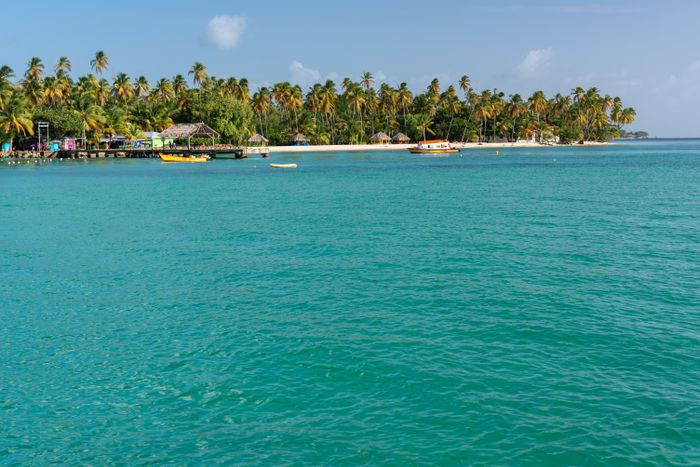
Two uninhabited cays at the far southeastern edge of the Bocas del Toro archipelago, ringed by some of the healthiest coral in the Caribbean, and ranked among the top 30 beaches on earth. Cayos Zapatillas are not a secret — but they are genuinely as good as the hype suggests.
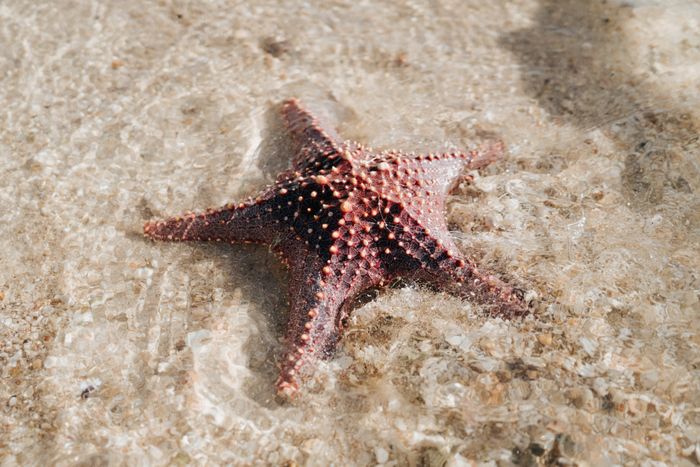
Most visitors to Bocas del Toro spend their days hopping between Starfish Beach, Red Frog Beach, and the bars of Bocas Town. That is fine. But if you have one full day to spend on the water, spend it here. The Zapatilla Cays sit inside the Isla Bastimentos National Marine Park — Panama's first marine park, established in 1988 — and the protection shows. The reef is intact, the beaches are undeveloped, and the only permanent structure on either island is a small MiAmbiente ranger station on the northern cay. No restaurant, no souvenir stand, no sun-lounger rental. Just white sand, coconut palms, and 80-plus coral species beneath the surface.
Section 01Why go to Cayos Zapatillas
The short answer: it is the best snorkelling in Bocas del Toro, attached to one of the most beautiful beaches in Panama, inside a protected marine park that has kept both in excellent condition. The longer answer involves parrotfish the size of your forearm, hawksbill turtles nesting on the shore between April and November, underwater caves you can duck into without scuba gear, and a boat ride through the archipelago that passes dolphins, sloths in the mangroves, and the kind of Caribbean light that makes every photograph look like it was edited.

In 2025 and 2026, Cayo Zapatilla was ranked among the top 30 beaches in the world by the World's 50 Beaches index — a distinction that reflects the cays' rare combination of pristine beach and healthy reef in a single location. The ranking has brought some additional attention, but the marine park's strict no-development policy means the islands themselves have not changed. There are no new facilities, no beach bars, no jet-ski rentals. The ranking is accurate, and the experience it describes is real.
The local legend about the name is worth knowing before you go. According to Bocas folklore, the two islands were formed when God stepped on the earth and left the impression of his sandals — zapatillas in Spanish. Look at a satellite map and you can see why the story stuck: both islands are narrow, curved, and roughly shoe-shaped. The legend has no single indigenous origin — it is a syncretic Bocas story, blending Spanish Catholic imagery with the kind of origin myth common across the Caribbean coast of Central America — but it is told by local guides with genuine affection, and it gives the cays a personality that purely geographic names rarely manage.
Section 02North vs South: which cay is better
Cayos Zapatillas consists of two distinct islands, and they are not interchangeable. Understanding the difference helps you get more out of your visit — and helps you ask the right questions when booking a tour.

Cayo Zapatilla Norte (North Cay) covers about 14 hectares. It is the smaller of the two and the one most day tours visit. The ranger station is here, which means the entrance fee is collected on arrival. The beach on the western side is the one that appears in most photographs: a long, calm arc of white sand with shallow turquoise water ideal for swimming and snorkelling from shore. The reef begins almost immediately off the beach — you can wade in from the sand and be over coral within 30 metres. The interior has a short jungle path that loops around the island in about 20 minutes. Most tour groups spend their beach time here.
Cayo Zapatilla Sur (South Cay) is larger at 34 hectares, less frequently visited, and arguably more dramatic. The western beach is wider and longer, with deeper shade from a denser palm canopy. The snorkelling on the southern and eastern sides is more advanced — stronger currents, deeper water, and more varied topography including the underwater caves that experienced snorkellers seek out. Tour operators occasionally bring groups here instead of Norte depending on sea conditions and visitor numbers. If your guide offers the choice, and you are a confident swimmer, ask for Sur.
Both islands are completely uninhabited. There are no toilets beyond a basic facility at the ranger station on Norte. Plan accordingly.
Section 03Snorkelling at Cayos Zapatillas: what you will actually see
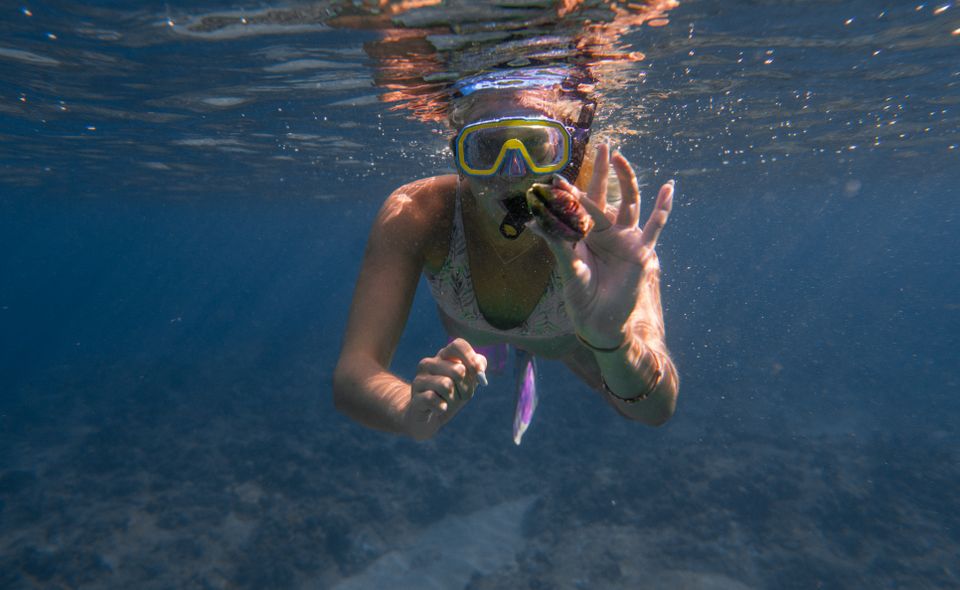
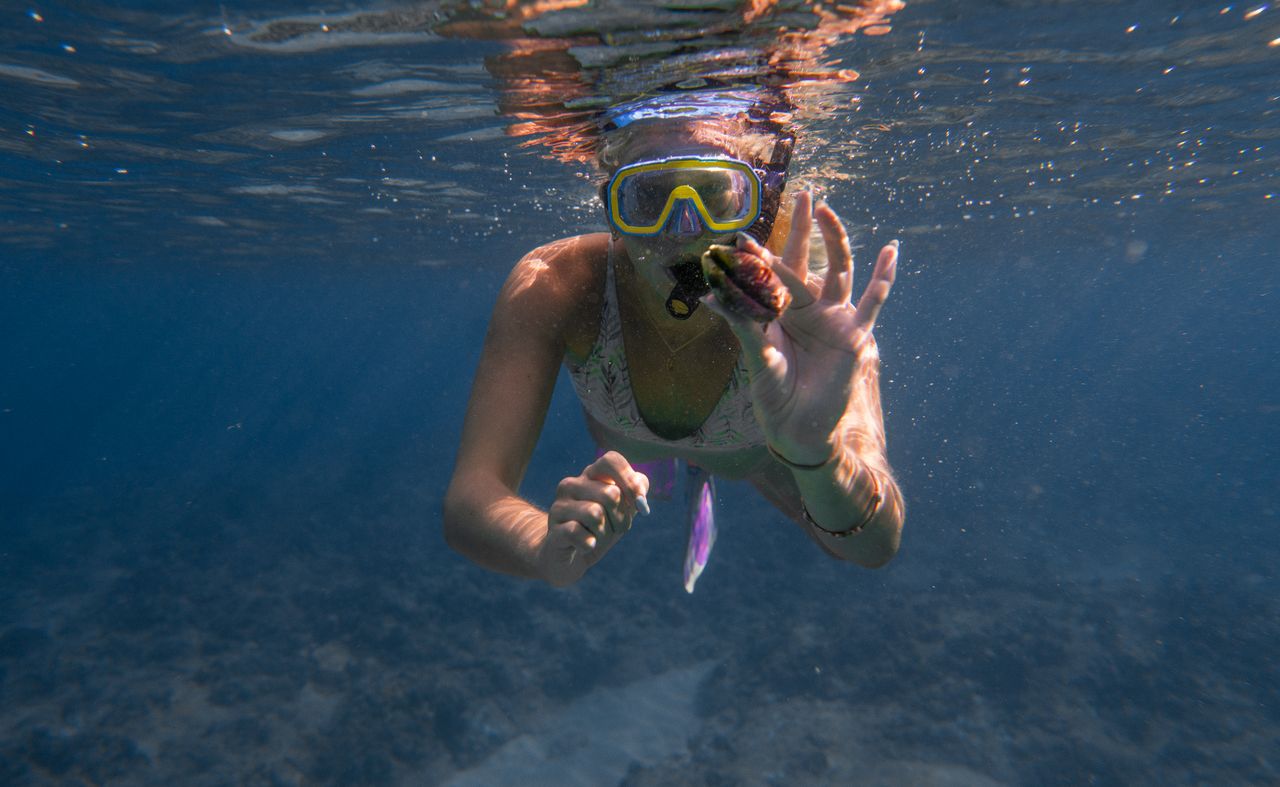
The reef surrounding Cayos Zapatillas is among the healthiest in the entire Bocas del Toro archipelago, and it shows in the species count. The park protects approximately 80 coral species, and visibility on a calm day typically runs 10 to 15 metres — significantly better than Hospital Point or the Coral Gardens near Isla Colón, where boat traffic and sediment reduce clarity. The water temperature stays between 27°C and 30°C year-round, so no wetsuit is needed.

What you will see in the shallows off Zapatilla Norte's western beach: parrotfish (stoplight and queen varieties are common), French and grey angelfish, blue tang in schools, four-eyed butterflyfish, sergeant majors, and snappers. The seagrass beds just off the sand hold juvenile fish and the occasional spotted eagle ray passing through. Moray eels are common in the reef crevices — green morays up to a metre long are regularly spotted, and they are habituated enough to human presence that they are visible rather than hidden.
Move around to the northern and eastern sides of Norte, or to the more exposed sections of Sur, and the species list expands. Nurse sharks rest on sandy patches between coral heads — they are docile and uninterested in snorkellers, but seeing a two-metre shark at close range in clear water is reliably startling. Queen triggerfish, lobsters wedged under coral overhangs, and iridescent Caribbean reef squid in small groups are all reasonably common. The underwater caves on the southern side of Sur are home to glassy sweeper fish in dense, shimmering schools.
One honest caveat: the snorkelling at Cayos Zapatillas is weather-dependent in a way that matters. After heavy rain, runoff from Isla Bastimentos can reduce visibility to as little as 3 to 5 metres on the western sides. Wind from the north and east — common during December and January — kicks up chop that makes snorkelling uncomfortable and can cancel tours entirely. The best snorkelling conditions coincide with the best overall weather windows: February through April, and again in September and October during the brief dry spell that breaks the main rainy season.
Section 04Sea turtles: nesting season, viewing ethics, and which island
Cayos Zapatillas are a critical nesting site for the hawksbill sea turtle (Eretmochelys imbricata), one of the most critically endangered marine reptiles on earth. Green turtles (Chelonia mydas) and leatherbacks (Dermochelys coriacea) also nest here, though in smaller numbers. This is one of the few places in Panama where you can observe nesting activity in a protected, ranger-monitored environment.
The nesting season runs from late April through early November, with peak activity in June, July, and August. Hawksbills typically come ashore at night to lay eggs, and hatchlings emerge roughly 60 days after laying. If you are visiting between June and September, there is a reasonable chance of seeing hatchling tracks on the beach in the early morning — the small flipper trails leading from the sand to the waterline are unmistakable. Actual nesting females are rarely seen during the day; they come ashore after dark, which is outside standard tour hours.
Both cays have nesting activity, but Zapatilla Sur's longer, wider beach sees more hawksbill nesting. Rangers on Norte can sometimes point out active nest sites marked with small stakes — do not approach marked nests, and do not dig in the sand anywhere on the beach.
If turtle conservation is a primary reason for your visit, contact MiAmbiente or a local conservation organisation in Bocas Town about volunteer monitoring programmes. Some operators run night turtle-watching excursions during peak season under ranger supervision — these are the only legitimate way to observe nesting females.
Section 05Getting there and the full cost breakdown
There is no public ferry to Cayos Zapatillas. Every visitor arrives by private boat, water taxi, or organised tour. The cays sit roughly 25 kilometres southeast of Bocas Town — about 1 to 1.5 hours by lancha (open fibreglass boat with outboard motor) depending on sea conditions and the route taken.

Option 1: Group day tour from Bocas Town
This is how most visitors get there, and it is the most cost-effective option. Tours depart from the Bocas Town waterfront between 9:00 and 10:00 AM and return around 4:00 to 5:00 PM. A standard itinerary includes stops at Dolphin Bay (to look for bottlenose dolphins), Sloth Island (a mangrove where three-toed sloths are visible from the boat), Coral Cay for snorkelling, Cayos Zapatillas for 2 to 3 hours, and Starfish Beach on the return.
| Option | Cost | Includes | Verdict |
|---|---|---|---|
| Budget group tour | $25–$35 pp | Transport, snorkel gear, park fee sometimes included | Best value |
| Mid-range group tour | $40–$50 pp | Transport, gear, park fee, cooler, guide | Most common |
| Private water taxi (full day) | $80–$120 total | Boat only — you set the itinerary | Best flexibility |
| Premium small-group tour | $80–$120 pp | Small group cap (~8), kayaks, lunch, guide | Best experience |
Park entrance fee: $10 USD per person for foreign visitors, payable at the ranger station on Zapatilla Norte. Some tour operators include this in the advertised price; many do not. Always ask before booking. Panamanian nationals pay a reduced rate.
Snorkel gear: Included in most tours priced above $35. On budget tours, gear may be an additional $5. Bringing your own mask is always better.
Lunch: Not included in most tours. The Coral Cay restaurant (a floating dock with a basic kitchen) serves grilled fish, rice, and plantains for around $12 to $18 per plate. It is overpriced relative to Bocas Town restaurants. Bringing your own food and drinks is entirely acceptable and significantly cheaper — just remember you are responsible for carrying all rubbish off the island.
Total realistic budget per person: $40 to $55 on a group tour with the park fee included. Budget $60 to $70 if you are buying lunch at Coral Cay. The $25 tours that appear on hostel notice boards sometimes do not include the park fee — confirm this before you hand over cash.
Section 06Best time to visit: month by month
Bocas del Toro does not have a simple dry season and wet season. It has a complex rainfall pattern influenced by the Caribbean trade winds and the Intertropical Convergence Zone, and the result is two relatively drier windows separated by two wetter periods. Understanding this is the difference between a cancelled tour and a perfect day on the water.
February to April is the primary dry season. Trade winds from the north keep rainfall low, seas are generally calm, and visibility underwater is at its best — often 12 to 15 metres off Zapatilla Norte. This is the peak tourist season, which means tours are fuller and accommodation in Bocas Town is more expensive, but the conditions are consistently good. March and April are the sweet spot: fewer visitors than February, still excellent weather.
May and June see the first rainy season arrive. Rain comes in heavy afternoon bursts rather than all-day drizzle, and many days are still fine in the morning. Tours run, but visibility can drop after rain. June marks the start of turtle nesting season, which is a reason to visit despite the wetter weather.
July and August are the wettest months. Tours are frequently cancelled, sometimes for several consecutive days. The Caribbean can be rough and grey. That said, peak turtle nesting happens now, and some travellers specifically come for this. If you are flexible and patient, you can still get a good day — but do not plan your entire trip around a single Zapatillas day in August.
September and October bring a second, shorter dry window — sometimes called the veranillo or little summer. Seas calm down, visibility improves, and the crowds thin significantly. This is arguably the best time to visit: good conditions, fewer tourists, turtle nesting still active. October is our top pick for the combination of all factors.
November to January is the second rainy season, with December and January also bringing strong north winds. Seas can be rough enough to cancel tours for days at a time. Water temperature is still warm, but conditions are unpredictable. If you are visiting Bocas in this window, build flexibility into your schedule.
Section 07Crowds, timing, and how to get more space
Cayos Zapatillas are the most popular day-trip destination in Bocas del Toro. On a good-weather day in high season (February to April), multiple tour boats will arrive at Zapatilla Norte within the same hour — usually between 11:00 AM and 1:00 PM. The beach can feel crowded during this window, though "crowded" by Caribbean island standards still means far fewer people than any beach near a major resort town.
The most effective crowd-avoidance strategy is to choose a tour that departs early — 9:00 AM rather than 10:00 AM — and prioritises arriving at the cays before the main fleet. Some operators, including Bastimentos Alive, explicitly build this into their itinerary: arrive at Zapatilla first, leave when the crowds come in, then head to Coral Cay for the quieter afternoon snorkel. Ask your operator about their arrival timing at the cays before booking.
A private water taxi gives you complete control over timing and duration. If you arrive at Zapatilla Norte at 9:30 AM, you will often have the beach almost to yourself for an hour. The cost premium over a group tour ($80 to $120 for the whole boat versus $40 to $50 per person) makes sense for groups of three or more who want to set their own pace.
Zapatilla Sur is consistently less crowded than Norte because fewer tours go there. If your priority is solitude over convenience, ask specifically for Sur — but be aware that the western beach is less sheltered and the snorkelling requires more confidence in the water.
Section 08How Cayos Zapatillas compares to other Bocas snorkel spots
Bocas del Toro has several snorkelling destinations, and they serve different purposes. Here is an honest comparison.

| Location | Reef quality | Visibility | Accessibility | Best for |
|---|---|---|---|---|
| Cayos Zapatillas | Excellent — 80+ coral species | 10–15 m on good days | 1–1.5 hr from Bocas Town | Best overall |
| Coral Cay (Cayo Coral) | Good — dense coral gardens | 6–10 m | 45 min from Bocas Town | Convenient stop |
| Hospital Point | Moderate — some bleaching | 4–8 m | 10 min from Bocas Town | Quick dip |
| Dolphin Bay | Low — seagrass, not reef | Variable | 30 min from Bocas Town | Dolphin spotting |
Coral Cay is the second-best snorkelling in the archipelago and is included on most Zapatillas tours as a stop. The coral gardens here are dense and colourful, and the floating restaurant makes it a practical lunch stop. Visibility is lower than Zapatillas because it is closer to Isla Colón and sees more boat traffic, but on a calm day it is genuinely impressive. Think of it as a warm-up for the main event.
Hospital Point, near Bocas Town, is convenient and accessible without a full-day tour, but the reef has suffered bleaching and the visibility is frequently poor due to proximity to the town's waterfront. It is worth a look if you have an afternoon free, but it is not a substitute for Zapatillas.
Dolphin Bay is not a snorkelling destination — it is a seagrass lagoon where bottlenose dolphins are reliably spotted from the boat. Most tours pass through it on the way to the cays. The dolphin encounters are genuine and often close; the snorkelling is not the point.
Section 09What to bring and practical tips
The Zapatillas are remote and completely undeveloped. Everything you need for the day has to come with you on the boat.
- Water: At least 1.5 litres per person. The sun and salt air are dehydrating, and there is nothing to buy on either island.
- Sunscreen: Use reef-safe, mineral-based sunscreen (zinc oxide or titanium dioxide). Chemical sunscreens — particularly those containing oxybenzone and octinoxate — damage coral reefs. The park does not currently enforce a reef-safe sunscreen rule, but the reef is the reason you are going. Use the right product.
- Food: Pack a proper lunch if you want to save money. Sealed containers, no single-use plastic if you can avoid it. Everything comes back off the island with you.
- Waterproof bag: You will wade ashore from the boat in waist-deep water on Norte. Your phone, wallet, and camera need to be waterproofed before you leave the boat.
- Your own mask: Tour-provided masks are often low quality. A decent silicone mask costs $25 to $40 and transforms the snorkelling experience.
- Cash in USD: The park entrance fee is paid in cash at the ranger station. Some tour operators collect it on your behalf; confirm before you go. ATMs in Bocas Town are the last ones you will see.
- Motion sickness medication: The boat ride to the cays crosses open water and can be rough, particularly in November through January and during afternoon return trips when the wind picks up. If you are susceptible to seasickness, take medication before departure — not after you start feeling unwell.
One final note on safety: the currents on the eastern and southern sides of both cays are stronger than the sheltered western bays suggest. Do not snorkel around to the exposed sides without checking with your guide first. The reef is more dramatic there, but so is the water movement. Stay within sight of the boat or a guide if you are exploring beyond the main beach area.
Cayos Zapatillas rewards the traveller who plans for it properly. Book early, go on a good-weather day, bring your own mask and lunch, and arrive before the mid-morning rush. Do all of that and you will spend a few hours in one of the genuinely great places in the Caribbean — a world-ranked beach with a world-class reef, inside a protected park that has kept both in the condition they deserve.